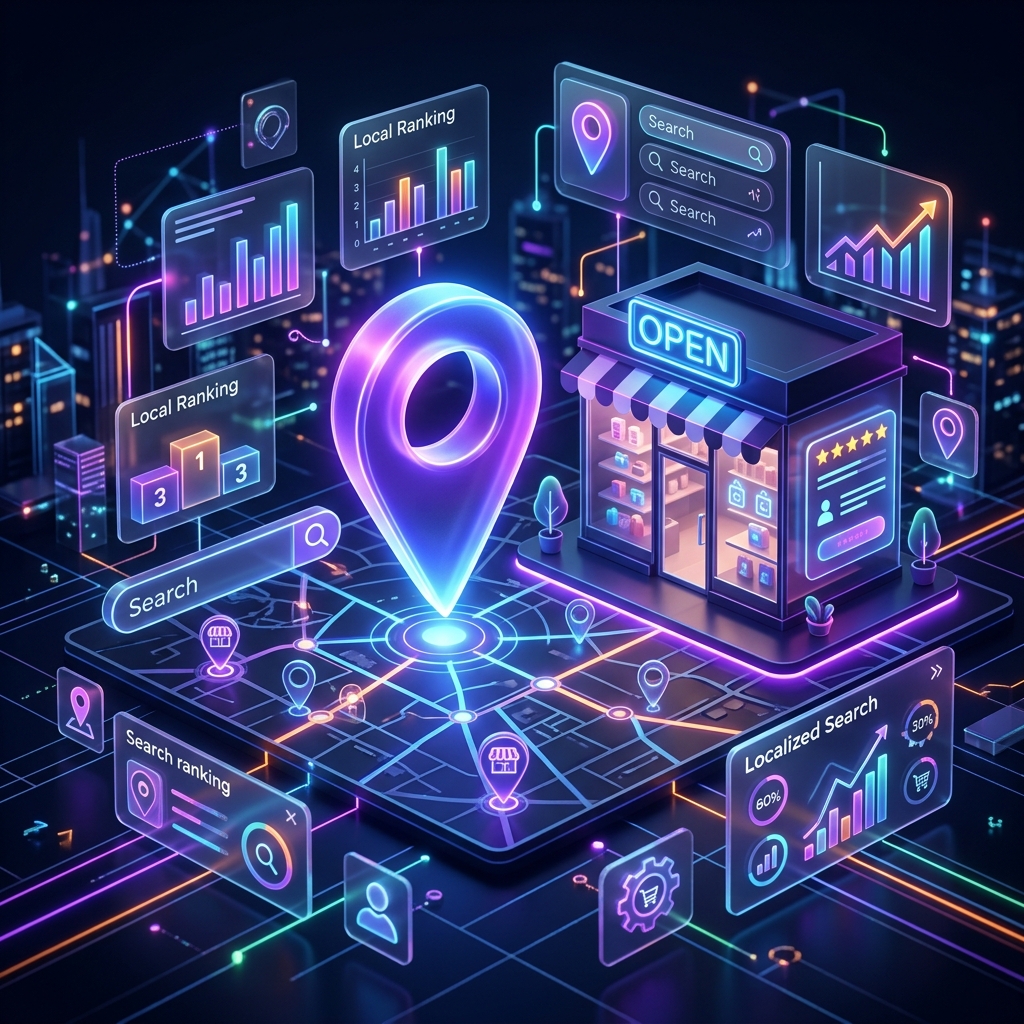
Local SEO isn't reserved for restaurants and hairdressers. In 2026, 46% of Google searches have local intent (SEMrush 2025 study), and e-commerce stores that overlook this lever are handing a substantial share of their market to less digitally capable physical competitors. Here's why and how to activate local SEO for your online store.
Why Local SEO Becomes Critical in 2026
Three converging trends are making local SEO impossible to ignore:
- "Near me" searches: +200% over 5 years according to Google. Users automatically add local context ("iPhone case near me", "wedding dress Lyon")
- Click & collect: 47% of French consumers used it at least once in 2025. It's now a standard expectation, not an optional feature
- Fast local delivery (24h, same day): customers prefer a retailer 50 km away who delivers in 24h over a national giant that takes 4 days
For e-commerce stores with stock in multiple regions, retail partners, or simply a locatable team, local SEO is an underused goldmine.
Pillar #1: Google Business Profile
Even without a physical store, you can create a Google Business Profile (formerly Google My Business) for your business. Eligibility requirements: a verifiable address and a phone number. Your registered office or warehouse is sufficient. The listing appears:
- In Google's local results (the "local pack" of 3 listings at the top)
- On Google Maps when someone searches for your brand or product category
- In rich snippets when someone types your brand name (right-hand panel with opening hours, reviews, contact details)
Minimum setup: exact business name, primary category ("E-commerce" or more specific), address, support hours, verified phone number, website link. Plus 10 quality photos (premises, team, products).
Pillar #2: Location Pages on Your Website
If you deliver to or stock products in multiple regions, create a dedicated page per geographic area: /delivery/london, /delivery/manchester, /delivery/birmingham. On each page:
- Delivery timelines specific to that area
- Local fulfilment options (partner pickup points, click & collect)
- Local contact information if applicable
- List of best-selling products in the region (localised UGC)
- Customer reviews from that area (local rich snippets)
These pages rank for queries like "[product] delivery [city]", which often have enormous cumulative search volume and low competition. This is typically 5 to 10× more cost-effective in effort-to-result than national queries.
Pillar #3: Schema.org LocalBusiness Markup
On your homepage and contact/about pages, add Schema.org LocalBusiness markup with:
@type: "LocalBusiness"(or more specific: Store, OnlineStore)addresswith street, city, postcode, countrygeowith latitude/longitude (Google Maps)telephoneopeningHours(support hours if no physical store)aggregateRating(average rating and number of reviews)
E-E-A-T tip
Activate Local SEO on Your Store?
Lexiik audits your local presence and recommends priority optimisations: Schema.org, location pages, Google Business Profile.
Audit My StorePillar #4: Collecting and Displaying Geolocated Reviews
Google Business reviews are the fuel of local SEO. Factors that boost local ranking:
- Volume: at least 50 reviews to register on the map, 200+ to dominate in a mid-sized city
- Frequency: Google values recent reviews. 5 reviews per month is better than a spike of 50 followed by nothing for a year
- Business responses: responding to 100% of reviews (positive and negative) significantly boosts local ranking
- Keywords in reviews: encourage customers to mention products, city, and context
Recommended workflow: send an automated email 7 days after delivery with a direct link to your Google Business listing. Average response rate: 5–10%. With 1,000 orders per month, that's 50–100 new reviews monthly — 600–1,200 per year. Impressive.
Pillar #5: Click & Collect as an SEO Lever
If you have a pickup point (your warehouse, a local partner, a physical store), create a dedicated page per location: /click-collect/london-shoreditch, /click-collect/manchester-city-centre. Each page should:
- List products available for immediate in-store pickup
- Display precise pickup hours
- Include an embedded Google Maps widget (strong local signal)
- Outline the terms (free of charge, no appointment needed, etc.)
These pages rank for very specific queries ("click and collect [product] [neighbourhood]") and convert at high rates — the user has already decided to buy, they're just choosing where to collect.
Special Case: Multi-Country and Multi-Language
If you sell across multiple European countries, create a Google Business Profile per country, ideally with a local address (registered office, partner, virtual office). A French listing won't rank in Germany. Correctly configured hreflang tags combined with local Google listings = optimal coverage.
Summary: Where to Start
- Create or complete your Google Business Profile (1 day)
- Add Schema.org LocalBusiness markup to your homepage (2 hours)
- Set up an automated review collection system (1 week)
- Create 3–5 delivery/click & collect pages by geographic area (1 week)
- Monthly monitoring of the "local pack" for 10 target queries (ongoing)
A store that masters these 5 pillars in 2026 captures 30 to 60% more traffic without cannibalising its own national pages. It's pure addition, not traffic displacement. Local SEO in 2026 is what mobile-first was in 2020: a competitive advantage available to those who act now.